Wednesday, 16 October 2019

“October Effect” – Fact or Fantasy..

The stock markets have its own superstitions, sayings and lunacies.
Some of them are connected with certain months, some with dates and some with specific days.
Old stock market adage says “Sell in May and Go away”, "The back to school trade is always down," and "Remember September always underperforms."
As per the Chinese calendar, August is considered a Ghost Month and it also impacts the stock market. For example, in Hong Kong, the number of initial public offerings (IPOs) drops to their lowest levels of the year during Ghost Month.
The January effect is a belief that seasonal increase in stock prices happens during the month of January. Analysts generally attribute this rally to an increase in buying, which follows the drop in price that typically happens in December when investors, engaging in tax-loss harvesting to offset realized capital gains, prompt a sell-off.
Similarly, The October Effect is the theory that stock prices will fall in the month of October.

Black Thursday and both Black Mondays happened in October in 1929 and 1987. The 2008 Great Recession kicked off in October.
But, downturns in 1987, 1990, 2001, and 2002 all bottomed out in October. In fact, the same day that the market just fell 800 points in October, it was the anniversary of when the Dow Jones bottomed out in 2002, having fallen 38.75% from its 2000 high.

October also reminds us of Halloween which has been reserved as a mysterious day since ancient times, a time of superstitions. “The Halloween Strategy,” or as it’s also known, ‘Sell in May and go away’, is another theory and investment technique in which an investor sells stocks before May 1, and refrains from reinvesting in the stock market again until October 31.

Investopedia says that from a historical perspective, October has marked the end of more bear markets than it has acted as the beginning, so maybe October means it's actually a good thing to celebrate.
September is statistically the worst month for investors, according to many researchers. In The US, September has had more down months compared to up months since 1928 and on average investors lose 1% in September and the average monthly return in October is 0.4%.

Some suggest that it’s as simple as the fact that when many investors choose to go on summer vacation, trading volume decreases. As the world’s leading stock markets are all dictated by cities in fairly similar temperate climate zones, the summer period is when most people working in business take their vacation, and less trading volume generally means less chance for high returns in the stock market.

The psychological impact of the crashes of 1907, 1929, 1987 and 2008 has spawned fears that the month of October is financially jinxed. Although September is statistically the worst month for investors, and there is no evidence proving anything more than a mere coincidence, The Stock Trader’s Almanac still refers to October as the “jinx month”

In the Indian Context, The biggest fall in a single month since inception happened in October 2008 which saw the Sensex crash by almost 25% per cent, from an opening figure of 13006 to a closing figure of 9788.06 and on 24th October, it touched the lowest point of 7697.39.

If you consider the October figures of the last 10 years, the worst was in 2009, when the index dropped 7.51 per cent in October and the best October returns were in 2010 when the Sensex gained by 9%.

In the current decade from 2010 to 2018, the Sensex gave a negative return on six out of nine occasions in October. Out of the 39 observations of the Sensex in October since Inception, Sensex has given a negative returns 22 times, thereby being negative 56.41% of the times as against an average of 41.73 % negative returns for all months.

Hence statistically, as is evident from the table, there is no clear pattern available regarding any calendar or month effect on the Sensex. The returns are influenced by far too many factors and calendar impact is at best random.
We shall like to end with the Mark Twain effect, which is the phenomenon of stock returns in October being lower than in other months. The name comes from a line in Mark Twain's Pudd'nhead Wilson: "October. This is one of the peculiarly dangerous months to speculate in stocks. The others are July, January, September, April, November, May, March, June, December, August, and February."
The quotation is a sarcastic assertion that speculation in stocks is always dangerous. The fact that Twain specifically picks out October initially may be taken as a reference to an "October effect", as exemplified by the 1929, 1987 and 2008 stock market crashes, which occurred in October.

As some wise men have rightly said, “Creativity is the ability to introduce order into the randomness of nature.” And “So much of life, it seems to me, is determined by pure randomness.”

In conclusion, we feel, “The October Effect” is just one of many superstitions that distract investors from doing fundamental and technical analysis of their existing and potential investments. There cannot be any substitute for knowledge, time in the market and good advise from a financial advisor.
Happy Investing!
Stay Blessed Forever
Sandeep Sahni


Note: All information provided in this blog is for educational purposes only and does not constitute any professional advice or service. Readers are requested to consult a financial advisor before investing as investments are subject to Market Risks.
About The author
Sandeep Sahni
Sandeep is an alum of IIM Lucknow with a Post Graduate Degree (MBA class of 1988). His also an alum of Shri Ram College of Commerce, Delhi University (B.Com. Hons. Class of 1985.)

Sandeep's investing experience and study of the Financial Markets spans over 30 years. He is based in Chandigarh and has been advising more than 500 clients across the globe on Financial Planning and Wealth Management.

He has promoted “Sahayak Gurukul” which is an attempt to share thoughts and knowledge on aspects related to Personal Finance and Wealth Management. Sahayak Gurukul provides financial insights into the markets, economy and Investments. Whether you are new to the personal finance domain or a professional looking to make your money work for you, the Sahayak Gurukul blogs and workshops are curated to demystify investing, simplify complex personal finance topics and help investors make better decisions about their money.

Alongside, Sandeep conducts regular Investor Awareness Programs and workshops for Training of Mutual Fund Distributors, and workshops and seminars on Financial Planning for Corporate groups, Teachers, Doctors and Other professionals.
Through his interactions and workshops, Sandeep works towards breaking the myths and illusions about money and finance.He also writes a well read blog;

He has also conducted presentations, workshops and guest lectures at Management institutes for students on Financial Planning and Wealth Creation.He can be reached at:+91-9888220088, 9814112988

Follow us on:
Blog Comment Policy
Your thoughts are vital to the health of this blog and are the driving force behind the analysis and calculators that you see here. We welcome criticism and differing opinions. We will do our very best to respond to all comments ASAP. Please do not include hyperlinks or email ids in the comment body. Such comments will be moderated and we reserve the right to delete the entire comment or remove the links before approving them.


Wednesday, 9 October 2019

What is Contrarian Investing?


In the plains of the African national parks an event gets played out on a daily basis. The moment an impala or a deer senses danger and starts running; the rest of the herd also joins the run. Many in the herd will not even know what triggered the running. Similar scenes can be observed in the plains of our stock markets too.
In times of euphoria, many investors are extremely eager to join the party by buying stocks of even unheard off companies. The moment any event that causes panic sets in, many investors wish to run away from the party in droves, even selling their core portfolio.
Doing the exact opposite of what the crowd is doing is what contrarian investing is mostly about and one, which gives the investors a better chance of profit.

Contrarian Investing is an investment strategy that is characterized by purchasing and selling in contrast to the prevailing sentiment of the time. A contrarian believes that certain crowd behavior among investors can lead to exploitable mispricing in securities markets.
Standing out from the crowd, many investors globally have built a reputation by betting against the market expectation.           
These Contrarian Investment Gurus are now known for their alternative bets, which have given enormous returns.
One of the most famous quotes of Contrarian Investing is by warren Buffet:“Be fearful when others are greedy and be greedy when others are fearful.”
Lets look into who and why did these Gurus use this strategy and how they created their own space in the investing world by going against the tide.
One famous contrarian investor, who was successful in bringing the Bank of England to its knees, is the legendary hedge fund manager George Soros.
The European Exchange Rate Mechanism (ERM) was set up in 1979 to reduce exchange rate variability and stabilise monetary policy across Europe. In 1990, Britain decided to join ERM in a view of unification of the European economies. But ERM had set an upper and lower limit within which exchange rates could fluctuate. Post joining ERM, Pound Sterling had an upper and lower limit of 6 per cent. However, the problem was that inflation in Britain was around three times higher than Germany and its economy was entering a phase of unsustainable growth, which added to the country's woes.
George Soros watched this scenario closely and he started taking a short position on Pound. On the other hand, to lure market participants and stop shorting of Pound, the government announced shocking rate hike from 10 per cent to 15 per cent. Unfortunately, the market did not take this move enthusiastically and Pound continued to fall, and the later government decided to withdraw itself from the European Exchange Rate Mechanism as it was losing billions and let the market revalue its currency to a more appropriate rate. Following this, Britain's economy suffered enormous losses and had to go through a massive slowdown.
From shorting Pound Sterling, Soros made a gain of nearly US$1 billion.
The most famous Contrarian Investor is the Legendary Warren Buffet, who ranks amongst the richest in the world. He has a large following in the investor community worldwide.
One of his contrarian bet led to a profit of nearly $US 20 million.
In 1963, Warren Buffet invested in American Express, which was in news for all the wrong reason. The bank had provided credit to Allied Crude Vegetable Oil considering its inventory of soybean-based salad oil. The inventory was kept on container ships thought to be full of salad oil. Actually, the containers were filled with water and had only a few feet of salad oil on top. Since the oil floated on top of the water, it appeared to inspectors that these ships were loaded with oil.
This scandal led to a loss of nearly US$58 million for American Express and triggered the fall in its share price.
But Warren Buffet conducted analysis in his own unique style and found that American Express competitive advantage and cash-flow generating capabilities were intact and the scandal did not stop people from using green cards issued by American Express.
Buffet bought nearly US$13 million shares of American Express and made nearly US$20 million profit post divestment of his stake in the company.
Warren Buffet has made a six-decade career out of buying boring but highly profitable companies at cheap or reasonable prices. He bought a struggling newspaper company, a chewing gum company, a bunch of banks, and a hundred other companies like that.
While everyone was loading up on overvalued tech stocks in the late 90’s, for example, he skipped that and bought 130 million ounces of Silver instead, which was at its historical low point. When the financial sector collapsed in 2008, he bailed some of them out, structuring very profitable deals for himself.
One of the best contrarian investors in the 20th century was Sir John Templeton,
who founded the Templeton Growth Fund; He started investing at a very early age. In 1939, he begged for a loan of US$10,000 and managed to get the same. He invested this amount in 100 stocks, which were trading below one dollar per share. This was a time when the Second World War started and the world was at the end of the Great Depression. Then he just kept an eye on those 100 stocks, which led the US out of the Great Depression. From his investment in 100 stocks, 34 companies went bankrupt, but the rest of the stocks fetched him a staggering 400 per cent return over the next five years.
His other famous contrarian bet was his investments in Japan in the '60s, when it was totally out of favour and no one really thought of investing there. Later, he also made huge profits from the tech bubble in 1999 by taking short positions in technology stocks.
Even in times of economic distress like during the 2008 housing bubble, contrarian Investment strategy has generated fortunes for smart Investors.
The best-selling book, “Big Short” describes the 2008 crisis and there is also an Oscar winning movie by the same name.
The story revolves around Michael Burry, manager of Scion Capital, who recognised in 2005 that the US housing market is going through a tough time and there is a serious threat of default in high-risk housing loans, which was later known as the sub-prime crisis. Michael Burry liquidated his position in April 2008 and generated accumulated gain of nearly 490 per cent.
We cannot always follow the trend; sometimes you need to take contrarian steps. However that requires a skill to detect a change in trend and also the conviction and courage to act on it.
Seth Klarman generated more than 16% annualized returns for over three decades, by analyzing the liquidation value of companies, and buying struggling companies at such low prices that his risk is kept at low levels.
Irving Kahn another legend, doubled his money from the 1929 market crash.  He recognized the bubble, shorted it, and made a killing, and went on to become the oldest active investor in the world until his death in 2015 at 109 years of age.
Bill Ackman is known for his high-profile short positions and activist investing. In the early 2000’s, for example, he began noticing the growing problem with credit default swaps and mortgage-backed securities, so he shorted MBIA, a major insurer of mortgage-backed securities. For several years, his investment didn’t pay off, until 2008 when the company’s value utterly collapsed and he walked away a much richer man.
India has also had its share of contrarian Investors and bets which have generated mega returns in the form of Eicher Motors, Wipro, Page Industries, Bajaj Finance, Titan, Havells, Symphony, TTK Prestige, Relaxo footwear and many more.
The most celebrated Indian investor is also famous for his contrarian strategies. Rakesh Jhunjhunwala, who is known for his risky investment bets, has made a huge fortune from his investment in Titan.
In the year 2002-03, Jhunjhunwala invested nearly 6 crore in Titan that too at Rs. 3 per share and over the years, he increased his stake and now Titan is trading at around Rs. 1,250 per share, resulting in huge wealth creation for Jhunjhunwala.
Titan's net sales were at Rs. 60.5 crore in March 2003 and have grown strong to reach Rs. 19,800 crore in March 2019.
We can go on and on with such examples; but for every successful example, there must be thousands and millions of unsung heroes who couldn’t make it and profit from their bets, because they made an exit too soon or had a leveraged position or couldn’t face the temporary downturn in their bet.
However, it is amply clear from any analysis of the markets that Investors created wealth when they invested during tough times and when they invested against the tide.
That reminds us of the famous quote of Baron Rothschild, who said, “the time to buy is when there's blood in the streets." Rothschild also made a fortune, buying in the panic that followed the Battle of Waterloo against Napoleon in the 18th century.
The strategy of dispassionately looking for value generally places you on the wrong side of the majority, which is a good thing.
There are many possible ways to practice a contrarian investing strategy. In an article on this topic, Prof. Aswath Damodaran, the renowned valuation expert, has listed four possible contrarian strategies one can adopt:
Biggest losers Buying into the biggest losers hoping that when the overreaction recedes, the stock will revert to the mean or normal levels.
Collateral Damage: This strategy is to look at situations where the market or a sector has turned negative, dragging the fundamentally sound stocks along with it
Comeback bet: This strategy involves analyzing the reasons for a drastic fall in price of a stock and taking positions in the security if you believe the reasons are temporary and fixable in nature.
“Long Odds” Option: This strategy involves analyzing the security (whose price has fallen for right reasons and there is no hope of a turnaround) to see if they have some proprietary technology, license, product that will increase the value of assets in the future.
All the key considerations for successful contrarian investing have been beautifully summarized by Howard Marks in the July 2013 memo to his Oak tree clients:
To be a successful contrarian, you have to be able to:
i) See what most people are doing,
ii) Understand what’s wrong about most people’s behavior,
iii) Possess a strong sense for intrinsic value, which most people ignore at the extremes,
iv) And resist the psychological pressures that make most people err, and thus,   
Buy when most people are selling and sell when most people are buying.
Before we kid ourselves to do a Buffet and search for our own Goldman Sachs or American Express like contrarian investing bet, let us remind ourselves of an old quote by the legend himself:
“Investing is simple but not easy” – Warren Buffet
This is equally true of contrarian investing also.
All this makes it a high-risk strategy for the common investor.
For the impala or deer in the plains of Africa, safety is in the numbers. In the eventuality of isolation from the herd their chances of survival becomes bleak.
Contrarian investing strategy can be extremely rewarding with possibilities for large profits when you get it right. It is a particularly useful investing strategy during periods of bubbles and extreme market over-reaction.
A large bet on a contrarian investment idea has the possibility to deliver windfall profits; It’s the equivalent of a jackpot or a royal flush in a poker game but adopting a contrarian approach blindly just for the sake of not following the herd can be an equally foolish thing to do. 
Contrarian Investment strategy also calls for a deep understanding of the market, knowledge about emerging sectors and companies which can deliver in the long run, apart from a lot of courage, ability to invest for the long term and conviction in your favourite idea.
You have to have the Patience to realize the full value of your bet because as
John Maynard Keynes famously said, “The market can stay irrational longer than you can stay solvent.”
It may take a very long time for the market to fall in line with your idea.
In the Indian context, Eicher Motors is a classic example of this. During early 2000, many thought Eicher motors was finished as the sales was floundering. The company was spectacularly revived and the share price moved from 220 in 2004 to touch a peak of 31000 in 2017 despite remaining at the 200 levels till 2009.
When people think of contrarian investing, they often think of high risk, high reward strategies, but that’s not necessarily the reality. What really counts is extensive research and deep conviction.
We suggest, you consult your financial advisor before you take a major contrarian bet, if for nothing else, only to get another perspective or reinforce your strategy.
Happy Contrarian Investing!
Stay Blessed Forever
Sandeep Sahni
Note: All information provided in this blog is for educational purposes only and does not constitute any professional advice or service. Readers are requested to consult a financial advisor before investing as investments are subject to Market Risks.
About The author
Sandeep Sahni
Sandeep is an alum of IIM Lucknow with a Post Graduate Degree (MBA class of 1988). His also an alum of Shri Ram College of Commerce, Delhi University (B.Com. Hons. Class of 1985.)

Sandeep's investing experience and study of the Financial Markets spans over 30 years. He is based in Chandigarh and has been advising more than 500 clients across the globe on Financial Planning and Wealth Management.

He has promoted “Sahayak Gurukul” which is an attempt to share thoughts and knowledge on aspects related to Personal Finance and Wealth Management. Sahayak Gurukul provides financial insights into the markets, economy and Investments. Whether you are new to the personal finance domain or a professional looking to make your money work for you, the Sahayak Gurukul blogs and workshops are curated to demystify investing, simplify complex personal finance topics and help investors make better decisions about their money.

Alongside, Sandeep conducts regular Investor Awareness Programs and workshops for Training of Mutual Fund Distributors, and workshops and seminars on Financial Planning for Corporate groups, Teachers, Doctors and Other professionals.
Through his interactions and workshops, Sandeep works towards breaking the myths and illusions about money and finance.He also writes a well read blog;

He has also conducted presentations, workshops and guest lectures at Management institutes for students on Financial Planning and Wealth Creation.He can be reached at:+91-9888220088, 9814112988

Follow us on:
 
Blog Comment Policy
Your thoughts are vital to the health of this blog and are the driving force behind the analysis and calculators that you see here. We welcome criticism and differing opinions. We will do our very best to respond to all comments ASAP. Please do not include hyperlinks or email ids in the comment body. Such comments will be moderated and we reserve the right to delete the entire comment or remove the links before approving them.

Monday, 7 October 2019

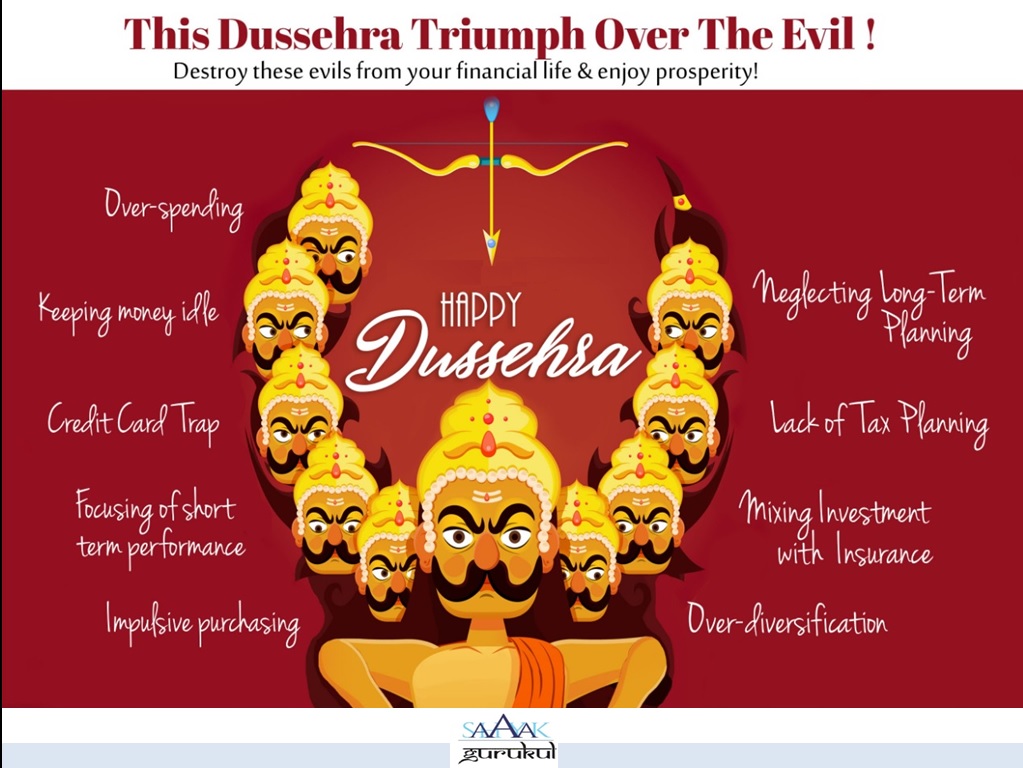
Conquer your financial sins this Dussehra!


The festival of Vijay Dashami, or Dussehra, symbolises the victory of good over evil.
There are four yugas widely accepted in Hinduism, Satya Yug, Treta Yug (Ramayana), Dwapara Yug (Mahabharata) and Kal Yug(Present)
In Satya yug, the fight was between two worlds (Devalok & Asuralok). Asuralok being the evil was a different World.
In Treta yug, the fight was between Rama and Ravana, both rulers from two different Countries.
In Dwapara yug, the fight was between Pandavas and Kauravas, both good and evil from the same family.
Kindly note how the evil is getting closer, For example, from a Different world to a Different country to the same family.
Now, know where does the evil reside in Kal yug?
It is inside us. Both good and evil live within us. The battle is within us.
Who will you give victory to, your inner goodness or the evil within?
The idea is how do we discipline ourselves and control the evil and demons within.
This Dussehra, how about first gaining victory over the financial demons of your life?
How about taking a pledge to get rid of the poor financial habits that damage your long-term wealth?
We all make several financial mistakes in our investment journey. Lets review our financial journey this Dussehra and take corrective action.
The 10 Financial Mistakes we all commit


1. Learn to be frugal
When Lord Rama along with Lakshmana and Sita were exiled for 14 years, they had to live a simple life, as opposed to the luxurious lifestyle of the royal palace; Lord Rama accepted his fate and maintained composure. Lets learn from Lord Rama, who even as a crown Prince, he did not mind sacrificing the luxuries and living a simple life during his period of exile.

You should also learn to be frugal in your spending. Learn to live in less than what you earn. By saving wisely, spending cautiously and investing smartly; you can apply financial discipline to cater to your current and future needs as well as your family’s needs. One way of inculcating and nurturing financial discipline within you is by firmly following a financial plan, avoiding overspending at all costs and investing in a regular manner.
2. Plan a strategy, don’t act on a whim
After Sita's abduction by Ravana, Lord Ram didn’t act on impulse. The legend speaks of Lord Ram taking time out to plan his strategy. He had it all in his mind as to where and how they would proceed to Lanka and rescue Sita.

You need to do something similar when dealing with money. Earning returns on your investment is not an easy task unless you plan it well. Ensure, that you have it all written down or at least have a mental framework. Take into consideration all the costs and risk while making this plan as well.
3. The power of conviction
Another important lesson to learn is the power of conviction. The entire Vanarsena had full faith in Lord Ram. That is how Ram Setu, the bridge connecting to Lanka was built by the Vanarsena. There is a famous tale of how they used to write the name of Ram on each stone or boulder they used to throw in the ocean and the stone used to stay afloat and not sink. This formed the foundation of the Ram Setu. This is the power of Conviction or faith. You need to also have a similar conviction in the Equity markets and your advisor. This conviction will take you across the ocean to victory and towards your financial goals.

4. Don’t look for shortcuts
Lord Rama fought the war with patience and perseverance and never thought of giving up or looking for short cuts.

The incidents in the Ramayana signify the importance of being patient and perseverant in the hardest of times. In your life too, you may face financial hardships or you may find it difficult to avoid unnecessary expenditure. As an investor, you may get impatient while watching your money grow or market ups and downs can test your patience to its extreme. This may force you to quit investing any further and derail you from achieving your financial goals. Irrespective of the above mentioned incidents; you must be patient and perseverant at all times.
5. Engage Specialists for different fields
Lord Rama consulted his advisors regularly and made strategy in consultation with them. He did not fight all the warriors himself but had specialists for each of the opposition warriors. Similarly don’t fight the battle alone. Consult your advisor and specialists and deploy funds in different asset classes to meet different goals. Diversify to reduce the risks.

6. Get rid of bad decisions
Burning the effigy of Ravan is symbolic of the victory of good over evil. In a similar fashion drawing analogy from this festival, we should get rid of our bad financial decisions. Review your portfolio and re-jig the same for a better financial plan than the one you have.

Credit card debt must be paid off;Expensive insurance can be replaced for cost effective and adequate Term policy. A home loan interest rate can be re-negotiated for a more competitive one. Or simply sell any bad investments in order to stop further loss. Whatever be the intensity of the bad financial decision, the essence is to let the bad be burnt so that good can prevail in our financial plan.
7. Start a new Chapter
After defeating Ravana and rescuing Sita, Lord Ram returned to Ayodhya to start a new chapter of his life. You need to do the same with your finances. When your money comes back with returns at the maturity of its term, it is now on you to make a new beginning. You choose to use it or reinvest it will determine your future, so use it wisely.

The festival of Dussehra symbolizes the victory of good over evil. The mythological stories of Lord Ram killing evil Ravana and Goddess Durga’s victory over Mahishasura teach us to curb our greed and throw away the bad intentions.
Draw some financial planning lessons from the auspicious occasion of ‘Dussehra’ and take charge of your finances while enjoying the festivities.
 Happy Dussehra! Hope this festival brings joy, success, financial freedom and happiness to you and your family.
Happy Investing!
Stay blessed forever.
Sandeep Sahni
Note: All information provided in this blog is for educational purposes only and does not constitute any professional advice or service. Readers are requested to consult a financial advisor before investing as investments are subject to Market Risks.


About The author
Sandeep Sahni
Sandeep is an alum of IIM Lucknow with a Post Graduate Degree (MBA class of 1988). His also an alum of Shri Ram College of Commerce, Delhi University (B.Com. Hons. Class of 1985.)

Sandeep's investing experience and study of the Financial Markets spans over 30 years. He is based in Chandigarh and has been advising more than 500 clients across the globe on Financial Planning and Wealth Management.

He has promoted “Sahayak Gurukul” which is an attempt to share thoughts and knowledge on aspects related to Personal Finance and Wealth Management. Sahayak Gurukul provides financial insights into the markets, economy and Investments. Whether you are new to the personal finance domain or a professional looking to make your money work for you, the Sahayak Gurukul blogs and workshops are curated to demystify investing, simplify complex personal finance topics and help investors make better decisions about their money.

Alongside, Sandeep conducts regular Investor Awareness Programs and workshops for Training of Mutual Fund Distributors, and workshops and seminars on Financial Planning for Corporate groups, Teachers, Doctors and Other professionals.
 Through his interactions and workshops, Sandeep works towards breaking the myths and illusions about money and finance.He also writes a well read blog; 

He has also conducted presentations, workshops and guest lectures at Management institutes for students on Financial Planning and Wealth Creation.
He can be reached at:+91-9888220088, 9814112988

        Follow us on:

Blog Comment Policy
Your thoughts are vital to the health of this blog and are the driving force behind the analysis and calculators that you see here. We welcome criticism and differing opinions. We will do our very best to respond to all comments ASAP. Please do not include hyperlinks or email ids in the comment body. Such comments will be moderated and we reserve the right to delete the entire comment or remove the links before approving them.

Tuesday, 1 October 2019

Money Lessons from the Mahatma

‘Mahatma Gandhi’ and ‘finance’ or ‘ Investment’ in the same sentence somehow don’t jell. Gandhiji was the epitome of non-materialistic living and had virtually no connection with money. But contrary to popular belief, and despite the above facts, there are certain Gandhian ideas that certainly could help in your financial journey.

Mahatma Gandhi’s life is filled with examples, which amaze us with his strength of character. His struggle for India’s freedom is all about his incredible patience, value based struggle, self-belief and persistence towards the goal of India’s Independence.

On the occasion of his 150thbirthday let us look at the preaching of this great man and find out how they can guide us in our investment and financial decisions.
Gandhiji strongly believed that business should exist as part of a healthy community in order to serve the community.
Much before the present government started the “ Make in India” campaign, Gandhiji started the Swadeshi movement as a part of the Indian Independence struggle. It was a strategy based on economic self-sufficiency, which aimed at boycotting foreign goods and reviving the domestic products, which will benefit the local traders, workers, labour and businessman. He wanted Indians to be self-reliant and Indian businesses to flourish so that it would help the local population.

Further, he believed in creating a balance, an equilibrium in society so that everyone could live in peace and harmony.


Here are some valuable investing lessons to learn from Gandhiji’s life and ideas:
Account for each rupee you spend and earn
During his law study in England, Gandhiji was as flamboyant as other Indian boys around. He learnt to dance and play the violin, bought an expensive watch and got himself tailor-made expensive suits. But he would always keep an account of every penny that he spent. One day he realized that he can’t keep wasting his money on such pleasures and not study law. He took out his account book, marked the items which were unnecessary and made up his mind to stop spending on frivolous items. He moved into smaller accommodation, took public transport and cooked cheaper food.
Once Gandhiji’s dhoti, i.e., his garment was torn, and someone said, ‘Bapu, your dhoti is torn.’ So Gandhi goes into the bathroom and adjusts his garments a little bit, and then says, ‘See now, and tell me where it is torn? There is a lot of it left to get torn.’


Everybody should have just enough for his or her needs
Gandhiji once said, “The World has enough for every one’s needs, but not enough for one man’s greed” Such a profound statement! We all have fallen into the “hoarding” trap at one time or the other; be it money, be it food, be it worldly pleasures.
We are afraid that this is thing is going to be not available in the future and we are greedy to accumulate as much as possible lest we miss the bus. We often fall for “buy 2 get one free” kind of offers and buy more than what we need whether it is clothes or in groceries. Let your children understand it too, because Fear and Greed are the two most important emotions we need to control in our investment journey.
It is Fear at the market bottom, that I will lose everything, which makes us sell and exit the market and it is greed which makes us invest the money at the market top, thinking that I must invest now or I shall miss the bus or the easy ride to wealth.
“The future depends on what you do today”
Have you ever found yourself saying this? ‘Yes, of course, I’m definitely going to make some investments and plan out my finances soon.’
This is one of the most common refrain of most would be investors, but alas most don’t start until it is too late.
The truth is, there’s no right or wrong time to start planning for your future. The only thing that really matters is that you start planning your finances as soon as you can. Don’t worry about how the markets are doing, or how young or old you are, or how much money you make in a month. If you have the time and the patience to start investing, then start planning, NOW.


Take the first step forward, even if it is small:
This refers to a feeling of, “What is the point of investing a small amount today, I will invest when I have something big to invest. However, just like the independence struggle where Gandhiji began all freedom movements on a small scale at first, it is more important that we start, with whatever small amount that we have and let compounding do the rest.

Practice more; preach less:
Gandhiji spent most of his time on actions rather than words. He was a great pragmatist. In the same way, we need to become people of action and stop just thinking and planning all the time. Start today because what you do today (or how much you invest today) is a lot more important that what you can do tomorrow.
At times, resilience is more useful than skills: Bapu was a force to reckon with and baffled the British about how a “puny half naked Fakir” could hold the British Empire to ransom. He single-handedly and non-violently spearheaded revolutions despite the brutal conditions,only goes to show his exemplary mental strength.
We have seen market events overwhelm the best of investors. This is where a calm and composed mind is a lot more useful than skill and talent. This is where you need persistence and single-minded focus on goal achievement despite the volatility of the events.As Mahatma Gandhi said “Strength does not come from physical capacity. It comes from an indomitable will.”
“Seek not greater wealth, but simpler pleasure

Despite what many ‘experts’ would tell you, financial planning isn’t just about making money. It’s about WHY you’re making money or why you want to make money. It’s about what you would like to do with that money when you finally have it.

Iam reminded of an old story, which fits in very well here.
A farmer had a dog that used to sit by the roadside waiting for vehicles to come.
As soon as one came he would run, barking and trying to overtake it.
One day a neighbor asked, "Do you think your dog is ever going to catch a car?"
The farmer replied, "That is not what bothers me.
What bothers me is what he would do if he ever caught one."
Many people behave like that dog that is pursuing meaningless goals.
They are trying to catch the elusive car, even if they catch it,
Then what?
Pursue only what you want to achieve.
The secret is to focus on the future that you require. Work with your financial advisor to clearly define your financial goals at different stages of your life. A host of factors come into play when you get down to doing this.
Your long-term milestones would include things like retiring early, sending your children to a good university, or maybe even going to university yourself. And your short-term milestones could be going on a long vacation, or deciding to learn a completely new skill, or being able to fund your hobby without digging into your savings.
What you need to remember is that running after high risk or high return investments or that elusive ‘Car” like the dog, isn’t what it’s all about, otherwise everybody would be doing just that.

Isn’t it ironical then, that the most that we remember of our ‘Father of our nation’ on this day, will be when we be digging into our wallets to hand over currency notes bearing his image, for our spending or curse him that today is a “Dry Day” because of him and we cannot enjoy our favourite Malt at the new Bar despite it being a holiday..

Whether humanity will follow the law of love, non violence and values propounded by Bapu, we don’t know, But that need not disturb us, The law will work just as the law of gravitation works whether we accept it or not.

Lets pay our humble homage to Gandhiji on his 150th Birth anniversary by following his principles and“Let's be the change that we want to see in the world.”

Happy Investing!
Stay Blessed Forever

Sandeep Sahni


 Note: All information provided in this blog is for educational purposes only and does not constitute any professional advice or service. Readers are requested to consult a financial advisor before investing as investments are subject to Market Risks.
About The author
Sandeep Sahni
Sandeep is an alum of IIM Lucknow with a Post Graduate Degree (MBA class of 1988). His also an alum of Shri Ram College of Commerce, Delhi University (B.Com. Hons. Class of 1985.)

Sandeep's investing experience and study of the Financial Markets spans over 30 years. He is based in Chandigarh and has been advising more than 500 clients across the globe on Financial Planning and Wealth Management.

He has promoted “Sahayak Gurukul” which is an attempt to share thoughts and knowledge on aspects related to Personal Finance and Wealth Management. Sahayak Gurukul provides financial insights into the markets, economy and Investments. Whether you are new to the personal finance domain or a professional looking to make your money work for you, the Sahayak Gurukul blogs and workshops are curated to demystify investing, simplify complex personal finance topics and help investors make better decisions about their money.

Alongside, Sandeep conducts regular Investor Awareness Programs and workshops for Training of Mutual Fund Distributors, and workshops and seminars on Financial Planning for Corporate groups, Teachers, Doctors and Other professionals.
 Through his interactions and workshops, Sandeep works towards breaking the myths and illusions about money and finance.He also writes a well read blog; 

He has also conducted presentations, workshops and guest lectures at Management institutes for students on Financial Planning and Wealth Creation.He can be reached at:+91-9888220088, 9814112988

        Follow us on:
Blog Comment Policy

Your thoughts are vital to the health of this blog and are the driving force behind the analysis and calculators that you see here. We welcome criticism and differing opinions. We will do our very best to respond to all comments ASAP. Please do not include hyperlinks or email ids in the comment body. Such comments will be moderated and we reserve the right to delete the entire comment or remove the links before approving them.